
Spinal Cord Stimulation in Flushing, Queens, NY
Minimally invasive interventional care with Dr. Ji Han in Flushing, Queens.
Management Experience
Trained Specialist
What is spinal cord stimulation?
Spinal cord stimulation uses a small device that sends mild electrical signals to the spinal cord to change how pain signals reach the brain. It may help chronic back or leg pain, nerve pain, CRPS and pain that continues after spine surgery when other treatments have not worked. At NY Spine Care in Flushing, Queens, it is performed by board certified pain specialist Dr. Ji Han. We accept most insurance, including Medicare, workers compensation and No Fault.
Spinal Cord Stimulation (SCS) for Chronic Back Pain and Nerve Pain Treatment Options
Spinal Cord Stimulation (SCS) is an advanced pain management treatment designed for people living with chronic nerve pain or persistent back pain that has not improved with medications, physical therapy, injections, or surgery. This minimally invasive therapy uses mild electrical signals to help block or modify pain messages before they reach the brain. A spinal cord stimulator is a small implanted device similar to a pacemaker that sends gentle pulses through thin wires placed near the spinal cord. These signals may help reduce pain in the lower back, legs, neck, arms, and other affected areas depending on the condition being treated.
Conditions Commonly Treated with Spinal Cord Stimulation
Spinal cord stimulation is commonly recommended for patients with chronic pain conditions that involve nerve irritation or failed previous treatments. It is often used for chronic lower back pain, leg pain caused by nerve compression, failed back surgery syndrome, sciatica, peripheral neuropathy, Complex Regional Pain Syndrome (CRPS), and neck pain that radiates into the arms in select cases. This therapy is usually considered when conservative treatments have not provided enough long-term relief.
Ask About This TreatmentHow Spinal Cord Stimulation Works
Pain signals normally travel through the nerves and spinal cord to the brain, where pain is felt. Spinal cord stimulation works by delivering gentle electrical impulses to targeted nerves near the spinal cord. These impulses help interrupt or modify pain signals before they reach the brain. As a result, many patients experience reduced pain levels, improved comfort, better movement, and a better overall quality of life.
Ask About This TreatmentTrial Procedure
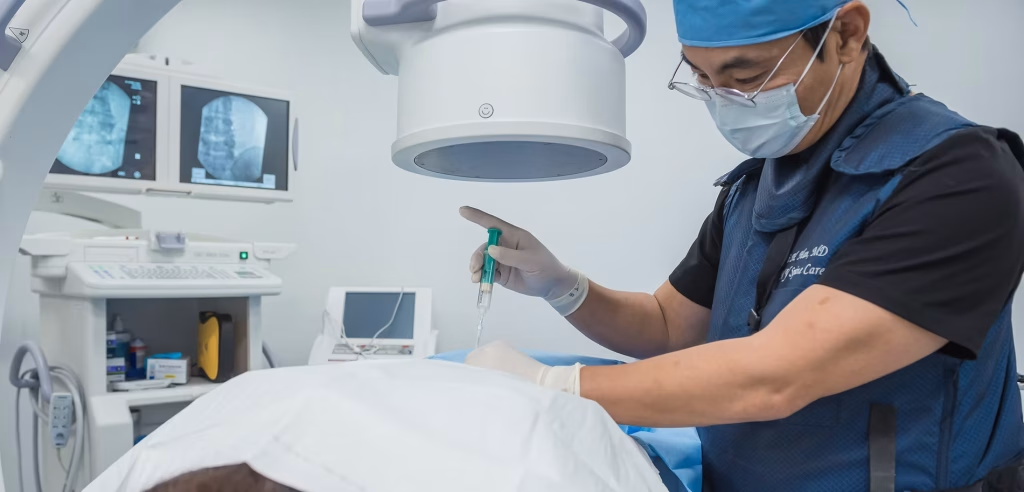
Before permanent implantation, most patients first complete a temporary trial procedure to determine whether spinal cord stimulation provides enough pain relief. During the trial, local anesthesia and mild sedation may be used while thin leads are inserted through a needle into the epidural space. These leads connect to an external battery worn outside the body. The trial usually lasts between three and seven days, allowing the patient to test pain relief during daily activities. If pain improves significantly, permanent placement may be recommended.
Ask About This TreatmentPermanent Implant Procedure
If the trial is successful, the patient may move forward with permanent implantation. During this procedure, sedation or anesthesia is provided while permanent leads are positioned near the spinal cord. A small battery generator is then implanted under the skin, commonly in the buttock or abdomen area. The leads are connected to the generator, and the device is programmed to match the patient’s specific pain relief needs. This procedure is usually performed on an outpatient basis or may require only a short recovery stay.
Ask About This TreatmentRecovery After Spinal Cord Stimulator Placement
After the procedure, mild soreness near the incision areas is common for several days. Patients are usually advised to avoid heavy lifting, twisting, and bending while healing takes place. Follow-up visits may be needed to fine-tune the stimulator settings for the best results. Patients also receive a handheld controller that allows certain adjustments for comfort and pain management.
Ask About This TreatmentBenefits of Spinal Cord Stimulation
Spinal cord stimulation can provide meaningful benefits for many patients living with chronic pain. It may help reduce pain intensity, decrease dependence on opioid or pain medications, improve mobility, and support better sleep and daily function. Because the therapy is adjustable and reversible, it offers flexibility that many other pain treatments do not. The ability to complete a trial first also helps patients decide if the treatment is right for them before permanent implantation.
Ask About This TreatmentIs Spinal Cord Stimulation Right for You?
Spinal cord stimulation does not cure the underlying cause of pain, but it can significantly improve quality of life by helping manage chronic symptoms. A pain management specialist will review your medical history, symptoms, imaging results, and previous treatments to determine whether you are a good candidate. For patients looking for a non-surgical chronic pain treatment option, spinal cord stimulation remains one of the most effective modern therapies available today.
Ask About This TreatmentSpinal Cord Stimulation in Flushing, Queens: what to know
A small device, a bit like a pacemaker, sends mild pulses through thin wires near the spinal cord to block pain signals before they reach the brain. It is adjustable and reversible.
Who it may help
Chronic back or leg pain, failed back surgery syndrome, sciatica, nerve pain (neuropathy) and CRPS, usually when other treatments have not given enough relief.
How it is done
You always try it first. During a trial of about 5 to 7 days, thin temporary wires connect to a small device you wear outside the body while you live your normal life. If your pain drops by at least half, a small permanent implant is placed under the skin of the buttock or abdomen as an outpatient procedure.
Recovery
Mild soreness for a few days. Avoid heavy lifting, bending and twisting while you heal. You get a handheld remote to adjust your settings.
How long relief lasts
It is designed for long term relief, and settings can be fine tuned at follow up visits.
Every patient is different, and results vary. Dr. Han will review your history and imaging to decide if this treatment is right for you.
Helpful reading about spinal cord stimulation
- What is the difference between a temporary scs trial and permanent implant?
- Risks and Benefits of Spinal Cord Stimulation
- Is Spinal Cord Stimulation Worth It?
- Latest Advancements in Spinal cord Stimulation Technology
- Who Should Consider Spinal Cord Stimulation?
- What to Expect During Spinal Cord Stimulation Trial?
Conditions Spinal Cord Stimulation may help
Spinal Cord Stimulation FAQs
Straight answers to the questions patients ask us most.
Spinal cord stimulation uses a small device that sends mild electrical signals to the spinal cord to change how pain signals reach the brain.
It may help chronic back or leg pain, nerve pain, CRPS and pain that continues after spine surgery when other treatments have not worked. Conditions it may help include Leg Pain, Nerve Pain, Spinal Stenosis, Sciatica, Peripheral Nerve Pain, Complex Regional Pain Syndrome.
It starts with a short trial so you can see how much it helps before deciding on a long term implant.
NY Spine Care is at 188-16 Northern Blvd in Flushing, NY 11358, and we see patients from Flushing, Bayside, Fresh Meadows, Whitestone, Little Neck and across Queens. Call 718-762-7000 or request an appointment online.
Locations We Serve for Spinal Cord Stimulation Treatment
We provide expert spinal cord stimulation treatment and specialized care for patients in Flushing, Queens, Bayside, Whitestone, Fresh Meadows, and surrounding areas across New York.
Is spinal cord stimulation right for you?
We accept most insurance, including Medicare, workers compensation and no fault.


